
Part 2 – The business case
Co-operatives need funds for a range of projects. The co-operative board should have already decided on a project consistent with the co-operative’s strategic plan. It may be to employ a new staff member, buy or build new assets or upgrade existing information or technology systems.
If the project cannot be funded from existing income or retained earnings, then the board needs to decide how best to fund it.
Part 2 of the Capital Builder helps co-operatives decide how to fund the project through developing a business case.
Preparing a business case is a process of collating and analysing information and forecasts, so funding options can be assessed in relation to the co-operative’s financial position, the nature of the project and the expectations of potential funders.
During the business case process, co-operatives should refer options to the board for consideration and to test funding ideas. This may mean frequent reviews and redrafts of the business case to reach a final point of recommending a funding option.
Developing the business case, below, guides you through the process of gathering information, assessing options and developing recommendations for consideration by the board.
You can download a template to use as a working document as you progress through the steps to prepare a business case.
If you require assistance, please contact the contact the BCCM. The BCCM provides information and referrals to professional co-operative advisors.
Developing the business case
1. Articulate the funding purpose and value
1.1 Purpose and amount of funds
The first step in the fund raising process is to articulate why the co-operative needs funds and how much is required.
Tasks:
- Draft a concise description of the project that needs funding. If there are multiple projects, such as refinancing existing debt or developing a new project, each project should be identified.
- Is the funding need short or long term?
- What is the funding time frame – is it required quickly or can it be accommodated by waiting or by receiving parts of the funding over time?
- Specify minimum and maximum funding amounts, where the minimum is the amount required for the project to proceed and the maximum is an amount that would comfortably deliver all components of the project, perhaps to a higher standard.
1.2 Member value
Co-operatives must create and deliver value to their members. Value may be financial or non-financial. Co-operatives that choose to offer securities, including more member shares, to members during the business case process should return to this item and include any direct financial benefits members may derive from investing in their co-operative.
Tasks:
- Refer to the previous board decisions for the project to articulate how the project contributes to the co-operative’s strategic plan or purpose.
- Identify the value that members can derive from the project, in the short term and long term. This may be a reduction in the costs of providing services to members or it may be the introduction of new or improved services to members.
- Are there potential financial rewards to members who invest in any securities to be offered? You can insert this now and review it later.
2. Funding options
Examining funding options requires finding a balance between what will work best for the co-operative and what investors are prepared to support.
The preferred funding option may be singular or a blend of funding sources. For example, bank funders may require members to increase their share capital before providing loan funds. Likewise, grant funding from government or philanthropic sources may require co-investment from members.
Identify the most appropriate funding option(s) by checking them against the following criteria.
2.1 Constitutional constraints
Part 1 of the Capital Builder identifies the funding options and identifies possible constitutional constraints for some options. Not all funding options will be available to all co-operatives.
For example, co-operatives that do not have share capital will not be able to offer shares to members. Only distributing co-operatives can undertake a compulsory share or loan scheme.
Tasks:
- Check funding options in Part 1 to determine the options that are available to the co-operative.
- Check whether the co-operative’s rules contain provision for the issue of Co-operative Capital Units (CCUs). If there are no CCU rules, then identify what needs to be done to permit this type of fundraising.
2.2 Membership profile
Consider the nature of the co-operative’s membership. The co-operative’s operations, the number and type of members and their engagement level indicate the potential for accessing funds from members. For example, a consumer co-operative with a large number of individual members, may find members are willing to invest small amounts in their co-operative, whereas a co-operative of larger businesses, that either supply to the co-operative or buy through their co-operative, may be willing to invest larger amounts, where the project will deliver benefits to their respective businesses.
Consider also whether the co-operative’s employees are likely to be attracted to investment opportunities offered by the co-operative.
Tasks:
Identify the characteristics of the co-operative’s membership in relation to:
- Number of members.
- Nature of member businesses or interest in the co-operative.
- Number of employees.
2.3 Costs and revenues
Examining the transaction costs for each available funding option is an important step in assessing whether a funding option is appropriate for the project. All funding options require internal staff resources to collate information and prepare the business case. Some options require expert financial, legal or accounting services, whose cost may place the funding option outside the co-operative’s reach.
Internal costs
Tasks:
Identify the internal costs for each of the funding options in relation to:
- Preparing of financial statements showing current status and prospective position of the co-operative. Staff resources may be able to produce current and prospective financial information or the co-operative may need to secure additional accounting services to produce prospective financial statements. A public offer will require the financial statements to be audited.
- Preparing grant and bank finance applications.
- Estimating external costs, if the funding option under consideration is a public offer of securities.
- Amending the co-operative’s rules, if required.
- Preparing and implementing a member engagement process.
- Preparing public offers of securities, particularly CCUs, is likely to require additional information to inform markets about the nature of co-operative and co-operative securities.
- Reporting requirements by the funding body, if funding is obtained, or if securities are offered.
- Systems to receive subscriptions for securities and constructing registers to record security issues are necessary and will require internal resources.
External costs
The more complex the funding option, the greater the need for expert professional advice and assistance.
Tasks:
Identify the potential external costs for each of the possible funding options. Identifying these costs requires advice from service providers about their fees. These include the costs of:
- Preparing financial statements and projected financial statements and any audit costs.
- Any legal advice about aspects of the funding options and for the preparation of any documents.
- Advice for the preparation of the terms of issue for a security, management of regulatory approval processes and testing and overseeing the marketing of securities.
2.4 Financial position and impact
Financial statements
The co-operative’s current financial statements and any forecast financial statements, based on different assumptions, will show the co-operative’s capacity to service the proposed funding and the potential revenue or value from the project.
As each available funding option will involve different costs, forecast financial statements need to demonstrate the financial impact of each of the available funding options.
Tasks:
- Prepare financial statements that show costs and revenues under different funding options.
- Identify the funding option(s) that meet the funding need with least cost.
2.5 Member value expectations
Having identified the cost and revenue impacts of funding options, revisit the scope or expected change to member value from the project.
For example, funding the project through borrowing from a financial institution or government loan program, will have no impact on member value other than the value created by the project, as identified in item 1.2. Other funding options, such as offering more shares or securities with distribution rights, can deliver additional financial rewards, as well as the member value to be derived from the project.
Tasks:
- What direct financial reward can be derived by members by funding the project under each option?
- What are member expectations in respect of value from the project? Are members interested in improved, cheaper or more services from their co-operative, or are they motivated by additional financial rewards? Member expectations may be known as a result of previous interactions or through member engagement and information sessions.
2.6 Capital profile
Fundraising will impact the co-operative’s balance sheet, by increasing either liabilities or capital. The capital profile before and after a fundraising affects the co-operative’s ongoing resilience and future funding opportunities.
Tasks:
Refer to the funding options in Part 1 and identify how each available option affects the co-operative’s capital profile and identify:
- What risks arise from the change to the capital profile?
- Are there any other impacts, positive and negative, from the change to capital?
- What action needs to be taken to manage any risks or negative impacts.
2.7 Taxation
The tax impacts of funding options are important. Interest payments on borrowings are tax deductible. For co-operatives that meet the definition of a co-operative company under the Income Tax Assessment Act 1936, distributions of dividends can be either tax deductible or franked. For certain co-operative companies, repayments of both capital and interest on certain government loans may be tax deductible.
Tasks:
- If a potential funding option includes offering securities or applying for a government loan, determine whether the co-operative meets the definition of a co-operative company and the potential tax benefit to the co-operative under these options.
- For debt funding options, estimate the value of the deductibility of interest payments.
2.8 Risks and risk management
Each funding option will have risks. These risks can be managed, but risk management measures have costs.
Task:
Prepare a risk management table that:
- Identifies the risk for each available funding option as high, medium or low;
- Includes risk management strategies; and
- Identifies costs, both internal and external, of any management strategies.
3. Market characteristics
Expectations of funders
A picture of the terms and conditions for each funding option is needed to understand the expectations of potential funders, comprising members and external lenders and investors.
Tasks:
Collate the following information:
- Interest rates for commercial lending from financial institutions.
- Standard terms and conditions for borrowing from financial institutions, especially requirements for security for borrowing.
- Interest rates on bank savings and term deposits as an alternative investment to members taking up co-operative securities.
- Availability of grant funds or government lending programs.
- Dividend rates for securities issued by other entities in the same industry.
- Dividends and rebates paid to members in previous years.
Impact investing
Not all funders are focussed solely on financial rewards and those focussed on non-financial impacts are not confined to grant funders.
The co-operative’s project may deliver a range of benefits to the local community or it may deliver wider benefits to the industry, by introducing modern and environmentally sustainable production systems. Equally, the project may evoke interest and support, because it satisfies the ideals of a group of people. Recent trends in impact investing, particularly through crowdfunding events, demonstrate a strong market for investment in projects that deliver environmental, health or welfare outcomes. Investors are prepared to accept lower financial returns if the project is expected to reliably deliver the desired non-financial outcomes.
Impact investing outcomes are sometimes linked to the United Nations Sustainable Development Goals (SDGs) or to other impact measurement systems, such as Environment, Social and Governance (ESG) investing criteria.
Impact investing requires the co-operative to establish a transparent and reliable method of measuring and reporting on impact to meet the expectations of impact investors.
Tasks:
- Identify the impact the project will deliver, such as increased employment, local community benefit, environmental sustainability or other health or welfare outcomes.
- Describe and cost the reporting system required for this type of investor.
4. Preferred funding option(s)
Having collated the information required, it is possible to reduce the number of funding options or identify a preferred funding option by assessing them against all the above criteria, including, their cost and revenue potential, how they meet the funding need, their impact on the co-operative’s capital profile and expectations of potential funders.
A good way to present the assessment is by using a table showing each available funding option and how it meets the criteria. A sample table is shown below.
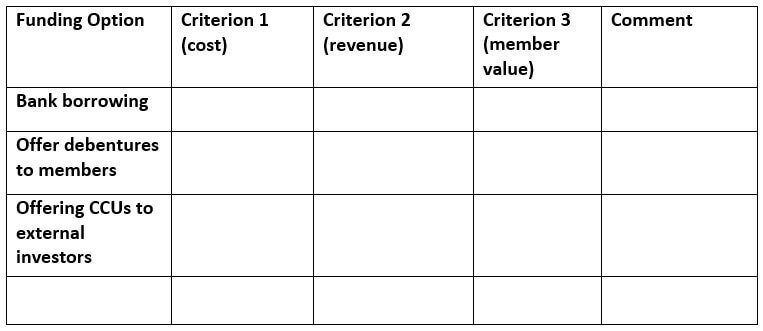
Based on this analysis, come to a conclusion about the preferred funding source and draft indicative terms for the funding, using the financial information that has been collated.
For example, if the preferred funding option is to borrow from a bank, indicative terms would include features that suited the funding need and recognised existing market characteristics, such as the term of the loan, the amount, to be borrowed whether the loan is interest only or includes repayment of capital, and what security is available.
If the preferred funding option is to offer securities to members or external investors, the indicative terms would include the minimum and maximum amount to be raised, the type of securities, and the terms of issue for the securities. Different terms of issue need to be developed for debentures and CCUs, and the terms will differ if the offer is made to members only or if it is open to external investors.
Download sample terms sheets for different types of security offers. You will need to complete a Term Sheet for an offer of securities in order to use Part 3 of the Capital Builder.
5. Recommendations for the board
It may not be possible to prepare final recommendations for the board from the initial business case data, if the preferred funding option is either not clear or further information is required.
Recommendations arising from this business case process may lead to reviewing the business case, by such things as enlarging and amending the amount of information in the business case, reviewing the assessment of funding options against the criteria or amending indicative terms for the funding.
If the preferred funding option is to apply for a bank loan, or grant funding, then the recommendations may include taking action to make the necessary application.
If the preferred funding option is to offer securities to members or to external investors, it will be necessary to undertake further testing of the market. This may require engaging with members and seeking advice from financial professionals. Market testing may result in redrafting the terms of issue or reconsidering funding options.
Recommendations should seek ‘in principle’ agreement on the:
- Funding source,
- Indicative terms for the funding, and
- Any next steps required to investigate or implement the funding option.
Ready to offer debentures or CCUs? Draft your disclosure documents.